
Last updated: September 2026 · Written by the ART NOVO management team
To choose a general contractor in Abu Dhabi, check five things before you sign:
- an active trade licence with general contracting as a registered activity, verified on ADDED
- a track record of permit submissions with the DMT
- completed villas you can visit
- an itemised bill of quantities (BOQ) rather than a lump sum
- a contract with milestone payments, 5–10% retention and a 12-month defects liability period
Choosing the contractor is the most consequential decision on any villa project. Get it right and you have a partner who protects your investment. Get it wrong and you join the Abu Dhabi owners who’ve had to hire a second contractor to rescue a failed build. ART NOVO has worked as the main contractor on first builds since 2014, and often as the recovery contractor on projects that went wrong elsewhere. This is the checklist we’d use ourselves.
What does a general contractor do in Abu Dhabi?
A general contractor takes single-point responsibility for delivering a construction or renovation project. Instead of you coordinating separate civil, MEP, joinery and finishing trades, the general contractor plans, procures, supervises and hands over the whole job. In Abu Dhabi that typically includes:
- Civil and structural works: foundations, frame, blockwork, waterproofing
- MEP: HVAC, electrical, plumbing, drainage and fire protection
- Interior fit-out: ceilings, flooring, joinery, finishes
- External works: boundary walls, paving, pools, landscaping
- Permits and inspections: DMT submissions through TAMM, utility and Civil Defence approvals, stage inspections and the completion certificate
- Project management: programme, procurement, quality control, health and safety, and variations
In Abu Dhabi, only a licensed contractor can apply for and carry out permitted building work. Owners cannot build villas themselves.
Who needs a general contractor?
- Villa owners building new, extending or doing a major renovation. One contract means one party accountable.
- Owners of community villas in Al Reef, Saadiyat, Yas or Al Raha, where developer NOCs and community rules add a layer of approvals.
- Businesses fitting out offices, retail or hospitality space, where delays cost money every day.
- Investors and developers with handover dates tied to sales or leases.
Check 1: Verify the trade licence
Direct answer: search the contractor’s trade licence number on the Abu Dhabi Department of Economic Development portal (ADDED). Confirm that (1) the licence is active, (2) general contracting is a registered activity, and (3) the licence holder matches the company named on your quotation. Don’t rely on a photocopy.
A contractor that submits building permits must also be registered to submit through the DMT’s systems. Ask for evidence of recent approvals and check the company’s file on TAMM.
Check 2: Visit completed projects, not just Instagram
Ask for three completed projects (not live ones), the client’s contact details and the handover date. Call those clients and ask: Was it finished on programme? Were there major cost overruns? Would you use them again? On site, look at tile-joint consistency, whether door frames are plumb, and how evenly the paint covers. These show the quality of site supervision.
Check 3: Demand a BOQ, not a lump sum
A professional quotation breaks down quantities, unit rates, brands and preliminaries. It’s the only way to compare contractors like for like, and the only basis for pricing variations fairly later. A one-page lump sum is a red flag.
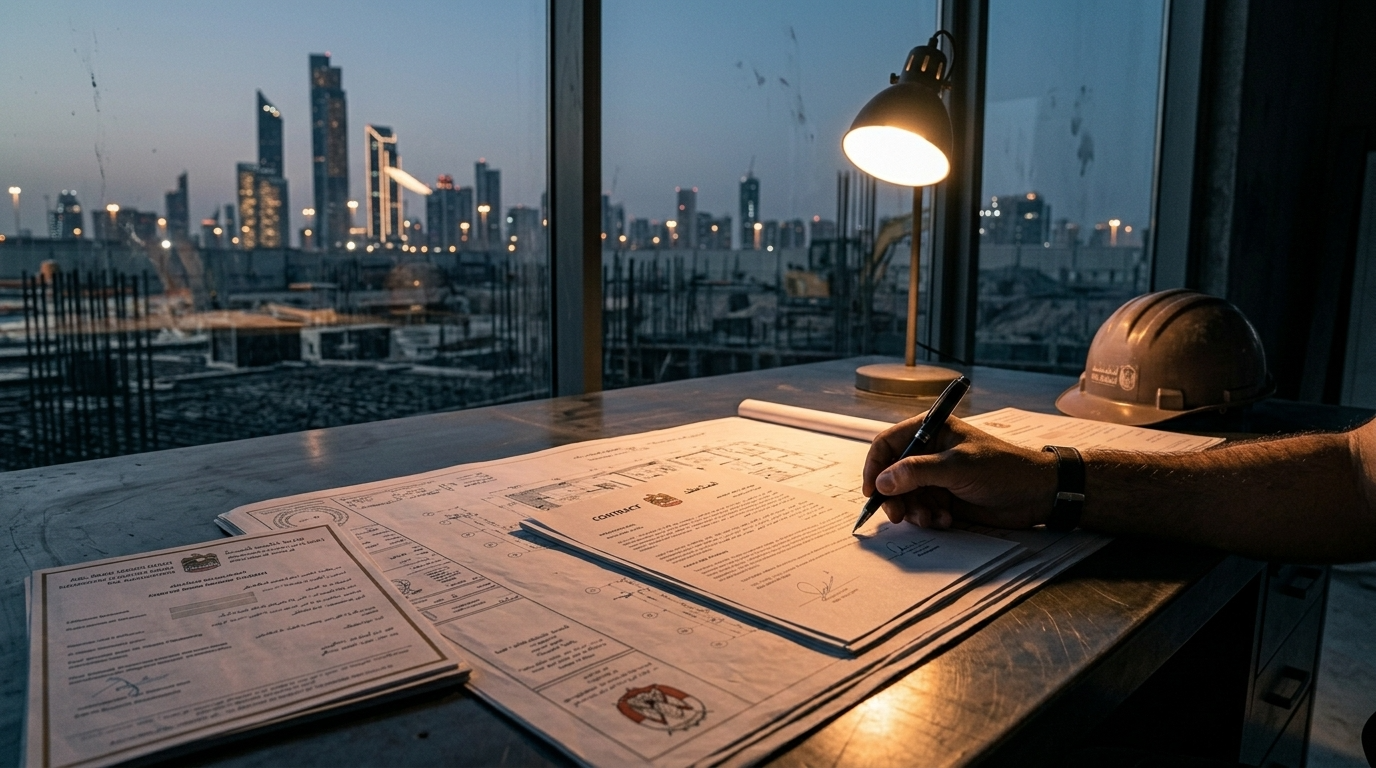
Check 4: Read the contract before you sign
Direct answer: an villa construction in UAE contract should include:
- full scope tied to specific drawings and specifications
- milestone-based payments (a 10–20% advance, then payment against certified progress)
- a construction programme with delay provisions
- a written variation procedure
- 5–10% retention
- a defects liability period of at least 12 months
Separately, UAE law makes contractors and designers liable for structural defects for 10 years. Our fit-out contract checklist goes clause by clause.
Check 5: Confirm who supervises your site
Ask directly: who is the site supervisor for my project, and how many other sites are they running? A contractor with 20 sites and 8 supervisors can’t give your villa daily, attentive oversight. At ART NOVO, site supervisors run no more than two projects at a time. It’s a limit we enforce deliberately.
Check 6: Test their material knowledge
A serious contractor can name the tile adhesive, the insulation specification and the HVAC brand they propose, and explain why each suits 45°C summers and coastal humidity. “Good-quality materials” usually means no established supplier relationships. See our guide to materials that survive Abu Dhabi summers.
Check 7: Confirm permit experience
Ask for recent DMT approvals, their process on TAMM, and who coordinates submissions. Clean submission packages come back approved; weak ones come back with comments, and every resubmission costs weeks. Permit management is a core contractor function, not an add-on.
Check 8: Review insurance certificates
At minimum: contractor’s all-risk (CAR) cover for the full project value, third-party liability of at least AED 5,000,000, and workers’ compensation for all site staff. Ask for the certificates themselves and check the expiry dates run past your completion date.
Check 9: Understand their programme and cash flow
Ask for a realistic programme. For a new villa, that’s 14–24 months including 4–8 months of design and permits. Treat a promise far shorter than that with caution. Unrealistic programmes and underpriced bids are how projects stall halfway. See our villa construction cost guide for realistic budgets.
Check 10: Judge the communication
Weekly progress reports, a named project manager, photo updates and a clear route for escalating problems. Poor communication is the root cause of most construction disputes, and how a contractor communicates during the tender is how they’ll communicate on site.
What are the red flags when hiring a contractor in the UAE?
Direct answer:
- they can’t produce an active trade licence immediately
- they ask for more than 30% upfront
- they have no verifiable projects completed in the last 24 months
- the quote is a lump sum with no BOQ
- the contract has no defects liability period
- they pressure you to sign before a legal review
- the site team doesn’t know the municipality’s inspection requirements
Talk to a contractor who welcomes these questions
ART NOVO has been licensed in Abu Dhabi since 2014. We price from BOQs, welcome site visits and give a 12-month defects liability period. See about ART NOVO and our construction services, or call +971 55 430 0003.
Frequently Asked Questions
How do you verify a contractor's licence in Abu Dhabi?
Search the trade licence number on the Abu Dhabi Department of Economic Development portal (added.gov.ae). Confirm the licence is active, that general contracting is a registered activity, and that the name matches the company on your quotation.
What should a construction contract in Abu Dhabi include?
Full scope tied to drawings and specifications, milestone payments (a 10–20% advance, then certified progress), a programme with delay terms, a variation procedure, 5–10% retention and a defects liability period of at least 12 months.
What does a general contractor do in Abu Dhabi?
A general contractor takes single-point responsibility for the project: civil works, MEP, fit-out, external works, DMT permits and inspections, procurement, quality control and handover. Only licensed contractors can carry out permitted building work.
What questions should I ask a contractor before hiring them in Abu Dhabi?
Who supervises my site, and how many other sites do they run? Can I visit three completed projects? Which DMT approvals have you obtained recently? Which HVAC brand, insulation and tile adhesive do you propose?
What are the red flags when hiring a contractor in the UAE?
No active trade licence, more than 30% upfront, no verifiable projects in the last 24 months, a lump-sum quote without a BOQ, no defects liability period, and pressure to sign before a legal review.